|
|
 |
Home> Technology>
Nano Silver >
Nano Technology

|
|
|
|
|
|
|
|
|
Nano is derived from
drawf in Greek
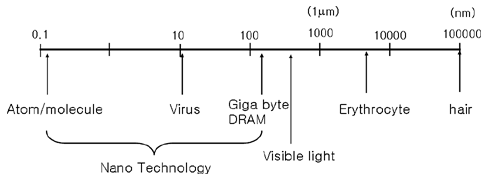
Nano is a prefix meaning 10-9. (1 nano-meter = 10-9
meter.)
c.f. 1m=100cm / 1cm=10mm / 1mm=1000µm / 1µm=1000nm
A red blood cell= ~7000nm / A bacterium= ~1000nm / A virus= ~100nm
1 nanometer is approximately 100,000 times thinner than a human
hair.
|
Nanotechnology is a rapidly growing science of producing and
utilizing nano-sized particles that measure in nanometers (1 nm = 1 billionth of
a metre).
The term nanoparticle is generally used to indicate particles with
dimensions less than 100 nanometers (one nanometer is one billionth of a meter).
For comparison, a human hair is about 100,000 nm in diameter, while a smoke
particle is about 1,000 nm in diameter.
The smallest nanoparticles, only a few
nanometers in diameter, contain only a few thousand atoms. These particles,
called quantum dots, can possess properties that are entirely different from
their parent materials.
|

In
general, physical, chemical, and biological properties of nanoparticles can be
selectively controlled by engineering the size, morphology, and composition of
the particles.
After
developing materials in this near-atomic size range, we can combine and exploit
the properties of the nanoparticle surface atoms to create new substances with
enhanced or entirely different properties from their parent materials.
In
short, nanoparticles allow industries to re-engineer many existing products and
design novel new products/processes that function at unprecedented levels.

Nanoparticles offer radical
breakthroughs in areas such as materials, healthcare, medicine, pharmaceutical, chemical, bio technology, environment technology and information technology.
Nano technology is the technology to produce nano size
particles of certain materials
for daily application. In the recent years, many
materials have been produced with the nano technology and Silver is one of the leading edge of the disinfections industry.
|
|
 |
| | |
| |